

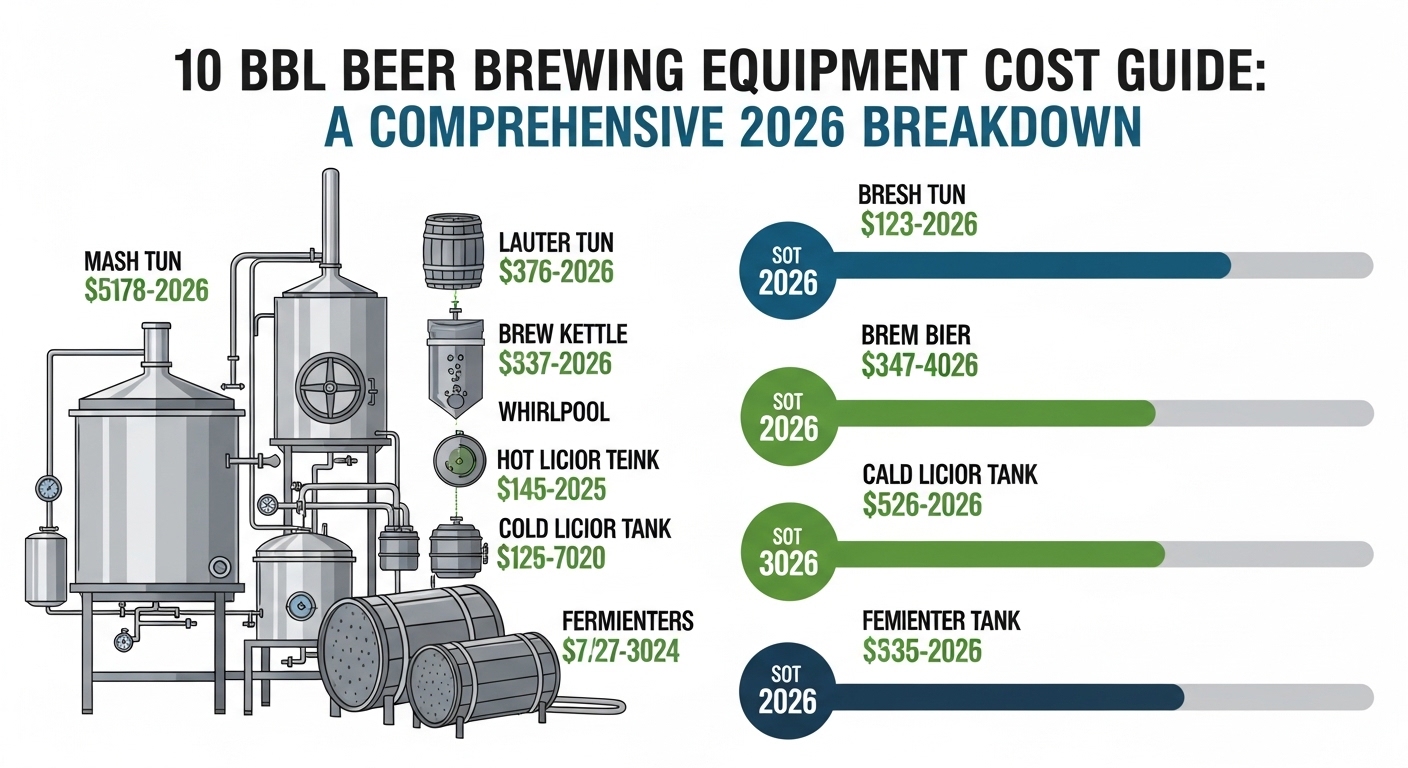
The 10 BBL (barrel) brewing system has long been considered the “goldilocks” size for the modern craft brewery. It is large enough to support a robust taproom and regional distribution, yet small enough for a single head brewer to manage without an army of assistants. As we navigate the economic landscape of 2026, the costs of stainless steel, specialized labor, and advanced automation have shifted, making a detailed cost guide more essential than ever for aspiring brewery owners.
Launching a 10 BBL brewery is a significant undertaking that requires a balance of high-quality engineering and smart financial planning. This guide breaks down every financial aspect of the 10 BBL equipment lifecycle, from the core brewhouse to the critical utility systems that keep the beer cold and the tanks clean.
The Core Investment: The 10 BBL Brewhouse
The brewhouse is the centerpiece of your operation. For a 10 BBL setup, you are typically looking at a two-vessel or three-vessel configuration. The configuration you choose will dictate your “turnaround time”—essentially how many batches you can brew in a single day.
Two-Vessel vs. Three-Vessel Systems
- Two-Vessel System ($95,000 – $140,000): Usually consists of a combination Mash/Lauter Tun and a Kettle/Whirlpool. This is the most popular choice for brewpubs with limited space. It is efficient but limits you to roughly two brews per day because one vessel must be empty before the next stage can begin.
- Three-Vessel System ($150,000 – $210,000): Features a dedicated Mash Tun, Lauter Tun, and Kettle/Whirlpool. This allows for “back-to-back” brewing, significantly increasing your weekly production capacity. If you plan on heavy distribution, the extra investment in a third vessel pays for itself in labor efficiency.
Heating Sources
The method you use to boil your wort impacts both your equipment cost and your monthly utility bills:
- Direct Fire: Often the cheapest upfront cost, using gas burners under the kettle. It is simple but can lead to “scorching” if not managed carefully.
- Electric: Very common in 10 BBL systems due to lower installation hurdles (no venting for gas). It is precise but relies on high-wattage immersion heaters.
- Steam ($20,000+ extra): The gold standard for commercial brewing. It requires a dedicated steam boiler but provides the most even heating and fastest boil times.
The Cellar: Fermentation and Brite Tanks
If the brewhouse is the heart, the cellar is where the soul of the beer is developed. Because fermentation takes anywhere from 10 days to several weeks, your cellar capacity must be significantly larger than your brewhouse capacity.
10 BBL and 20 BBL Unitanks
Most modern 10 BBL breweries use “Unitanks”—jacketed, conical fermenters that allow for fermentation, yeast harvesting, and carbonation in a single vessel.
- 10 BBL Jacketed Unitank: Generally costs between $8,500 and $11,500 per tank.
- 20 BBL Jacketed Unitank: Many brewers buy “double-sized” tanks to save on floor space and cost-per-gallon. These range from $16,000 to $22,000.
A standard startup package usually includes four to six 10 BBL fermenters, representing an investment of $40,000 to $70,000.
Brite Beer Tanks (BBTs)
Brite tanks are used for final clarification and serving. While some brewers serve directly from Unitanks, having a dedicated Brite tank frees up your fermenters for the next batch.
- 10 BBL Brite Tank: Expect to pay $7,500 – $9,500 per vessel.
Critical Utility and Support Systems
A common mistake for first-time owners is under-budgeting for the “back-of-house” systems. Without these, the shiny stainless steel tanks are useless.
Glycol Chilling System
To control fermentation temperatures and “cold crash” your beer, you need a commercial-grade glycol chiller. For a 10 BBL system with a standard cellar, a 10-15 HP chiller is required.
- Estimated Cost: $35,000 – $55,000 (including the chiller, insulated piping, and manifolds).
Grain Handling and Milling
Processing hundreds of pounds of malt per batch requires more than a bucket and a prayer.
- Two-Roll Mill: $6,000 – $8,500.
- Grist Case and Auger: To move the crushed grain to the mash tun automatically, budget $5,000 – $10,000.
Clean-in-Place (CIP) Systems
A dedicated CIP cart allows you to sanitize your tanks using high-pressure spray balls and heated chemicals without scrubbing.
- Portable CIP Cart: $6,000 – $12,000.
Packaging: Kegging and Canning
The final step is getting the beer to your customers. In 2026, the “can-first” model remains dominant, but kegs are the lifeblood of the taproom.
Kegging Costs
- Semi-Automatic Keg Washer: $12,000 – $18,000. This is an essential piece of equipment to ensure food safety and prevent “souring” of your lines.
- Keg Fleet: A typical 10 BBL brewery needs at least 300–500 kegs to maintain a rotation. At roughly $110 per keg, this is a $33,000 – $55,000
Canning Lines
If you intend to sell your beer in liquor stores, a canning line is non-negotiable.
- Entry-Level Micro-Canner (15-25 cans/min): $75,000 – $110,000.
- Ancillary Packaging Gear: Labelers, date coders, and pak-tech applicators can add another $20,000 to the line.
Hidden Costs: The “Soft” Expenses
When calculating your total 10 BBL equipment cost, you must include the “soft” costs of getting that equipment into your building and operational.
- Shipping and Logistics: 10 BBL tanks are large. Depending on whether they are coming from a domestic or international manufacturer, freight and customs can cost $15,000 – $30,000.
- Mechanical Build-out: You will need a licensed plumber for the glycol and water lines, and an electrician for the control panels. This often costs 15% to 25% of the equipment’s value.
- Rigging: Renting forklifts or cranes to move the tanks into place can cost $5,000 – $10,000.
Summary of Total Estimated Costs (10 BBL)
Category Low-End Estimate High-End (Automated) 10 BBL Brewhouse $95,000 $210,000 Cellar (6x 10 BBL Tanks) $51,000 $85,000 Glycol & Utilities $35,000 $60,000 Grain Handling $11,000 $20,000 Packaging (Kegs & Canner) $90,000 $180,000 Installation & Shipping $40,000 $80,000 TOTAL $322,000 $635,000
Why Choose Micet Group for Your 10 BBL System?
When investing over a quarter-million dollars into a brewing system, the manufacturer’s reputation is your greatest insurance policy. Micet Group has emerged as a global leader in providing precision-engineered 10 BBL systems that bridge the gap between affordability and professional-grade durability.
Micet Group’s equipment is crafted from certified 304/316L stainless steel, featuring world-class welds and highly intuitive PLC control systems. Their 10 BBL configurations are designed with the “brewer’s workflow” in mind, offering ergonomic platforms and optimized vessel geometry for high-gravity brewing. Beyond just the hardware, Micet provides comprehensive engineering support, helping you design your floor plan and utility connections to ensure a seamless installation. If you are looking for a partner who understands the nuances of craft beer—from IPAs to delicate lagers—Micet Group is the standard-bearer for quality.
Frequently Asked Questions
- Can a 10 BBL system fit in a standard retail space?
A 10 BBL system generally requires between 2,500 and 4,000 square feet, including the taproom and cold storage. The height is also a factor; you will typically need at least 12-14 foot ceilings to accommodate the fermentation tanks and their associated piping.
- Should I start with 10 BBL fermenters or jump straight to 20 BBL?
If you have the capital, “double-batching” into 20 BBL fermenters is the most efficient way to grow. It allows you to produce twice the beer for only a marginal increase in tank cost and almost no increase in cleaning time. However, starting with 10 BBL tanks is better for maintaining a diverse tap list with more variety.
- What is the typical lead time for a new 10 BBL equipment order?
In the current market, lead times range from 5 to 9 months. This includes the time for design finalization, manufacturing, pressure testing, and shipping. It is vital to order your equipment as soon as your lease is signed, as the build-out of the facility often takes a similar amount of time.
 IQnewswire