
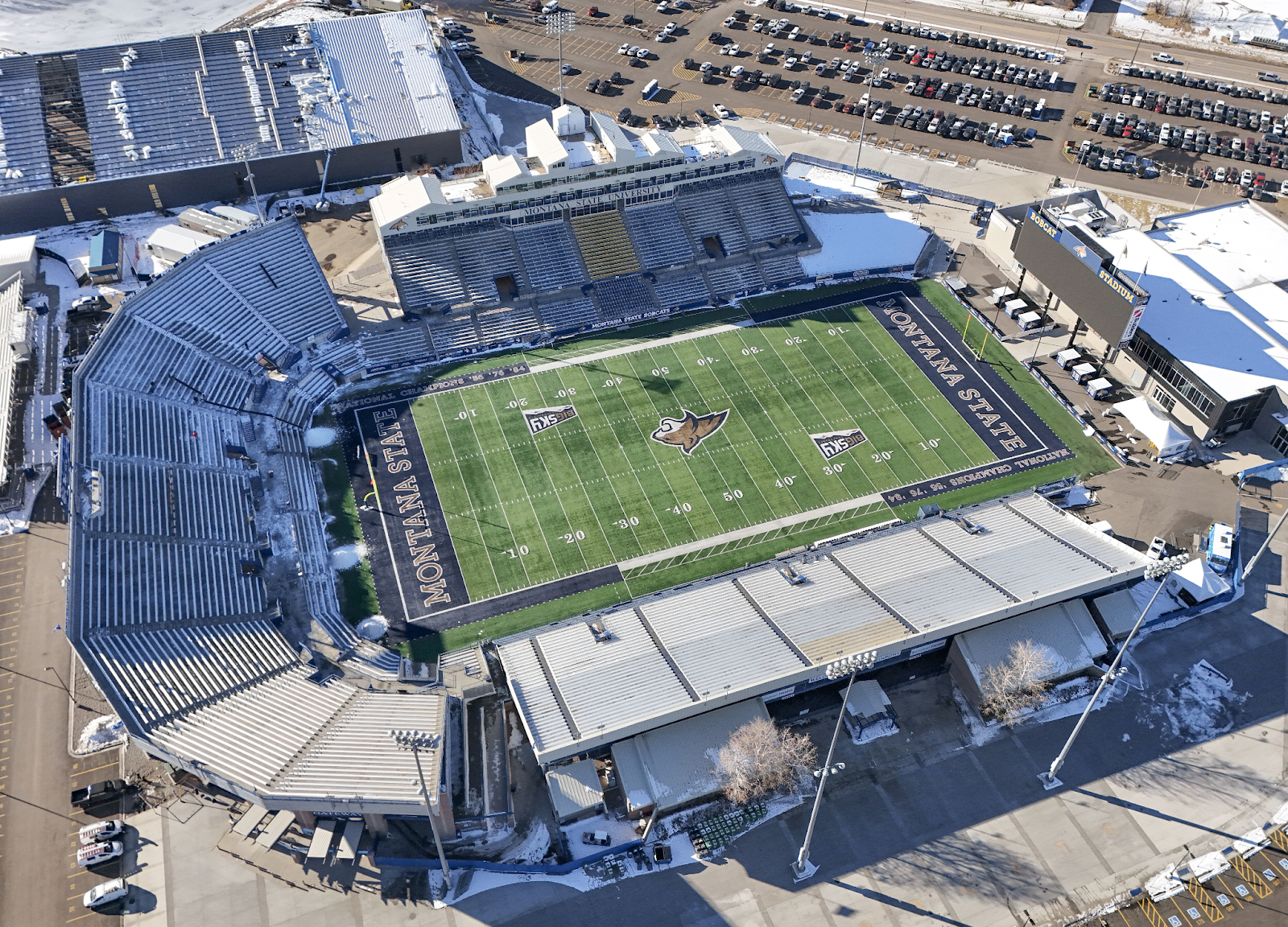
“Bobcat Stadium” Licensed Under CC BY-NC-ND 4.0
For most states, the launch of legal sports betting has been followed by tremendous financial success. But it is a different story in Montana.
Big Sky Country legalized sports betting back in May 2019. The industry’s journey since then has featured many twists, turns, hiccups and underwhelming developments. Even the launch itself was riddled with sketchiness. Montana technically rolled out services in December 2019, but couldn’t accept bets until that March.
Not every stage of Big Sky Country’s sports betting era has been as turbulent. Yet, the terms of its legalization have contributed to people believing they’re missing out on earning potential. As of now, only one sports betting provider is allowed to operate inside the state, under the jurisdiction of the lottery department.
Although many are not thrilled about the sports betting experience in Montana, the operator in question won another seven-year contract during the latter half of 2025. The move was not unexpected, but that hasn’t stopped many from poring over the fallout. State officials are worried they’re leaving revenue on the table as Montanans explore what they deem more reliable options. Not only may they be crossing state lines, but customers can still flock toward what Bob Duff of Vegas Betting notes in his BetUS sportsbook review are “recognizable names in the offshore betting space.”
Of course there is no way of knowing how much more money the state budget can generate with a different setup. However, experts believe it could be millions of dollars per year.
Montana May Have Completely Botched Its Handling of Legal Sports Betting
More than a half-decade into the Montana sports betting era, you’d expect the state to have worked out most of the bugs. That apparently isn’t the case.
The buck stops with Intralot, a Greek technology and sports betting company that has exclusive operator rights in the state. They recently earned a new contract despite their tenure being littered with regulatory infractions, operational problems and fines. If you are wondering why the state kept them around, well, you are most certainly not alone. The answer, though, is quite simple: money. Intralot came in substantially cheaper than the competition, even undercutting its own price point from the previous contract.
Add it all up, and you get a sports betting market in disarray. As Darrell Ehrlick writes for the Daily Montanan, the state might be seeing its foothold in the industry deteriorate at a time when nearly everyone else is seeing gradual or unchecked growth:
“But, the state of the state’s sports lottery isn’t quite as rosy. Intralot, a multinational company, has struggled with a series of fines and missteps throughout the United States. For example, in Washington, D.C., this year, it was at the center of a scandal that cost the company $6.5 million in fines. While some states, like Idaho, have re-upped contracts with the company, Ohio pulled its contract after a series of problems with its betting kiosks. Meanwhile, at about the same time Montana agreed to a new contract with Intralot, it also brokered a deal with Maryland that has recently collapsed.
“Also, a new revenue report suggests that Montana’s cut of sports revenue may be falling. And new research by experts says the state’s restrictive approach may be costing it millions in revenue from offshore sports betting companies, which have become much easier to use through virtual private networks and cryptocurrency.”
This is a special type of surreal given the state of sports betting at large. Even as prediction markets have infringed upon the industry, most states are still seeing their share of sports betting revenue rise. If Montana’s cut is falling, something needs to be done.
The Montana Sports Betting Market May Be Stuck
Opponents of sports betting will celebrate Montana’s more limited rollout. Having one provider limits accessibility relative to other states who have multiple, sometimes dozens of, online sportsbooks operating in the market.
To what end, really, is this a victory, though? If Montana truly wanted to limit sports betting’s impact, it should not have been legalized in the first place. By green-lighting it, they are obligated to maximize—both for consumer safety and state revenue.
Montana seems to be failing on both fronts. And there is no clear solution, either.
Consumer safety might be the easier issue to solve. More guardrails can always be added to the transaction process. Reverse engineering declining revenue is an altogether different beast.
Expanding the market to feature more Montana online sportsbooks would typically be the way to go. But it isn’t clear how much latitude the state will have after signing a seven-year contract—that could extend to 10 years—with Intralot under the terms it will be the region’s sole provider.
Failing the ability to renegotiate terms, the Montana sports betting market may be stuck. That is great news for surrounding states, as well as reputable offshore betting sites. It is bad news, and frankly, a fundamental failure for Montana’s approach and execution of this entire process.