For many high school and college students in the USA, a 2,000-word research paper or a complex rhetorical analysis feels like a hurdle to jump over—a box to check before the semester ends. Whether you are navigating the Common App in high school or tackling senior capstones at university, the effort can feel disconnected from “real life.” In the 2026 academic climate, where the Return on Investment (ROI) of a degree is under constant scrutiny, you might find yourself asking, “When will I ever need to write a thesis statement in the professional world?”
The answer is more practical than you might think. While you may never write another formal MLA-style essay after graduation, the cognitive framework, ethical reasoning, and communication discipline you develop through academic writing are the very engines that drive career progression in the American workforce. From the Freshman writing seminar to a summer internship in DC or Silicon Valley, your ability to structure a thought is your greatest asset.
1. The Bridge Between Critical Thinking and Professional Problem Solving
Academic writing is not just about grammar; it is about structured thinking. To write a successful university-level paper, you must gather data, analyze conflicting viewpoints, and synthesize them into a coherent argument. In the professional world—whether you are in tech, Wall Street finance, or healthcare management—this process is renamed “Strategic Planning” or “Business Analysis.”
When you learn to move from a vague idea to a structured academic argument, you are training your brain to:
- Identify Core Issues: Sifting through noise to find the “thesis” of a business problem.
- Evidence-Based Reasoning: Backing up your professional suggestions with data, much like using citations in a paper.
- Logical Flow: Ensuring that a project proposal leads the reader naturally from a problem to a solution.
In 2026, employers have shifted toward skills-based hiring. They aren’t looking for someone who can “write an essay”; they are looking for someone who can research a market trend and present an AI-human hybrid workflow that results in a unique, non-generic solution.
2. Establishing Authority and Executive Presence
In the USA, “Executive Presence” describes the qualities of a leader. A significant portion of this presence is conveyed through the written word. If you are a student aiming for leadership roles, your writing acts as your “digital handshake.”
A well-structured email, a clear project brief, or a persuasive white paper signals that you are organized and authoritative. Conversely, poor writing can act as a “career ceiling.” We often see brilliant technical minds fail to move into management because they cannot articulate their vision to stakeholders. When you practice academic rigor—perhaps by analyzing complex market data through an economics essay writing service — you are essentially practicing the “language of leadership.”
3. Navigating the “Remote-First” American Workplace
The landscape of American work has shifted. With the rise of Slack, Zoom, and asynchronous workflows, writing has replaced “watercooler talk.” In a remote or hybrid environment, your colleagues and managers may only know you through your written output.
Strong academic writing skills allow you to:
- Eliminate Ambiguity: Reducing the need for “meetings about meetings” by writing clear, concise instructions.
- Persuade Without Presence: Winning over a client or a supervisor through a written proposal without needing to be in the room.
If you struggle with the transition from casual texting to formal professional tones, seeking foundational support for academic standards can provide the bridge needed to close that gap. Many students find that professional modeling, such as seeing experts writing essays for money , helps them grasp the structural nuances required to ensure they won’t be “lost in translation” in their future career.
4. Human-Centric Writing in the Age of Agentic AI
As we move further into 2026, “Agentic AI”—AI that can act as an independent agent—is everywhere. However, this has actually increased the value of human academic skills. Academic writing teaches you how to be an editor of your own thoughts. It teaches you to check facts, verify sources, and ensure that the “voice” behind the text is credible. Students who use Myassignmenthelp.com to understand the mechanics of a good argument are better equipped to direct AI tools effectively. You aren’t just “using AI”; you are managing the logic layer of an AI-human hybrid workflow.
5. The Power of Persuasion (The Professional “Thesis”)
Every time you ask for a raise, pitch a new product, or apply for a grant, you are essentially writing an argumentative essay. Academic writing teaches you the classical Aristotelian appeals:
- Logos (Logic): Using stats to show why your department needs more budget.
- Ethos (Credibility): Citing your previous successes to build trust.
- Pathos (Emotion): Connecting your project to the company’s mission.
Students who master the art of the “persuasive essay” find themselves miles ahead in corporate negotiations. They understand that a “pitch” is just a thesis statement supported by evidence.
6. Attention to Detail: The “Zero-Error” Standard
In academic writing, a misplaced citation or a formatting error can result in a lower grade. In the professional world, a typo in a contract or an error in a financial report can cost a company millions.
The discipline required to proofread a 15-page term paper builds the “editorial eye” necessary for high-level American professions. It builds a habit of excellence and a refusal to settle for “good enough.” This is the difference between a Junior Associate and a Senior Manager.
7. Digital Literacy and Information Architecture
Writing a research paper in 2026 requires navigating a sea of digital information. You have to distinguish between “fake news,” AI-generated hallucinations, and peer-reviewed data.
When you organize a paper into headings, subheadings, and a bibliography, you are practicing Information Architecture. In the corporate world, this is how we build websites, organize databases, and create internal knowledge bases. If you can’t organize a 2,000-word essay, you won’t be able to organize a 200-person project.
8. How to Cultivate These Skills While in School
If you are currently a student, don’t view your assignments as chores. View them as career simulations.
- Seek Feedback: Understanding why a paragraph didn’t flow will help you write better emails later.
- Vary Your Reading: Read journals and business reports to see how “academic” rigor is applied in the real world.
- Utilize Expert Guidance: Don’t be afraid to use writing services or tutors to mastering complex structures. These platforms offer guidance on formatting and logic, helping you internalize the standards expected in the American professional sphere.
9. The Global Advantage for International Students in the USA
For international students, mastering academic writing is the fastest way to level the playing field. The USA is a meritocracy that rewards those who can communicate their value. High-quality writing removes the “language barrier” and focuses the employer’s attention on your ideas, not your syntax. It proves you can navigate the complex cultural and professional expectations of the US market.
10. Ethics, Integrity, and the Professional Code
Finally, academic writing teaches the importance of Academic Integrity. In the workplace, this translates to Professional Ethics. Citing your sources in a paper is the precursor to giving credit to your team members in a meeting. Avoiding plagiarism is the precursor to respecting intellectual property in business. In a world of AI-generated content, being the person who can verify and vouch for the ethical standing of a document is a high-value trait.
Conclusion: Writing Your Way to the Top
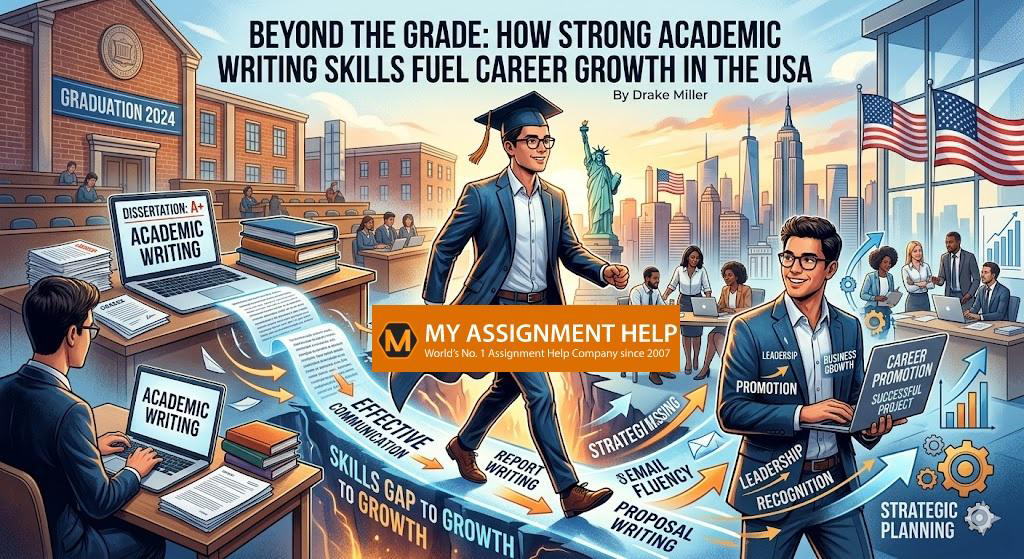
The journey from a high school classroom to a corner office in New York or a tech hub in Austin is paved with digital documents. Your GPA might get you your first interview, but your communication skills—honed through years of rigorous academic writing—will get you the promotion.
Stop seeing essays as obstacles. Start seeing them as the training ground for your future. When you learn to command the English language, you learn to command a room, a board, and a career.
Frequently Asked Questions
Q.1 How does writing an essay help me in a non-writing career (like Engineering or Nursing)?
In technical fields, academic writing translates to documentation and safety. An engineer must write clear project specs to avoid structural failure; a nurse must maintain precise patient records to ensure proper care. The “discipline of detail” you learn in a research paper is the same discipline that prevents costly professional errors.
Q.2 What is “Executive Presence” and how does my writing affect it?
Executive presence is the ability to project confidence and authority. In a digital-first workplace, your writing is your primary brand. A disorganized, poorly researched email signals a disorganized mind. Clear, evidence-based writing signals that you are ready for leadership and can communicate complex ideas to stakeholders.
Q.3 How can Myassignmenthelp.com improve my long-term career prospects?
Myassignmenthelp.com serves as a bridge for students who need to understand the “why” behind academic standards. By providing structured examples and guidance on complex formatting, these resources help students internalize the “Zero-Error” standard and logical flow required in high-level American professions.
Q.4 Will practicing academic writing help me with remote work?
Absolutely. Remote and asynchronous work relies almost entirely on written communication. If you can move from a vague idea to a structured argument (the core of an essay), you can eliminate the need for “meetings about meetings,” making you an invaluable asset to any remote team.
About the Author – Drake Miller
I am a dedicated blog author associated with Myassignmenthelp.com, where I create insightful and student-focused content. My writing aims to simplify complex academic topics, offer practical study tips and guide learners toward better academic performance. Through engaging and informative blogs, I strive to support students in achieving their educational goals with clarity, confidence and ease.
